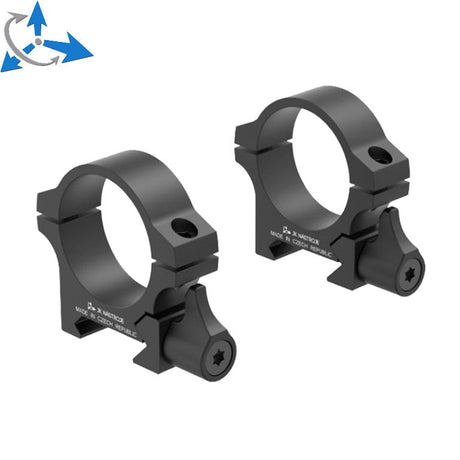
This collection contains scope rings and one-piece scope mounts. They hold your rifle scope on the base of the rifle. You choose rings by three points: the main tube diameter of your scope, the base on your rifle and the height. The range includes rings from JK-N and CZ in the Czech Republic, Contessa in Italy and Davika.
Step 1: main tube diameter
The rings must match the main tube of your scope exactly. A ring of the wrong size cannot hold the scope. The common diameters are:
-
1 inch (25.4 mm): common on classic hunting scopes and on many rimfire scopes.
-
30 mm: the most common diameter today. Most rifle scopes in our range have a 30 mm tube.
-
34 mm: used on scopes for long-range shooting, which need a large adjustment range.
The tube diameter is in the specifications of your scope. See Scope rings by diameter.
Step 2: the base on your rifle
The rings must also fit the base on your rifle. This collection covers three base types:
Step 3: ring height
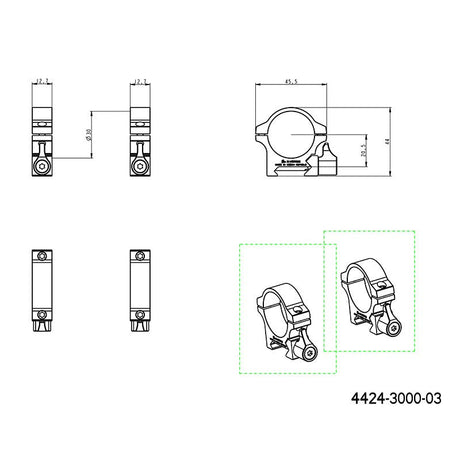
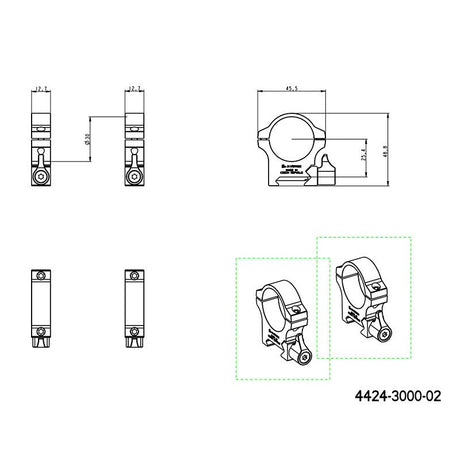
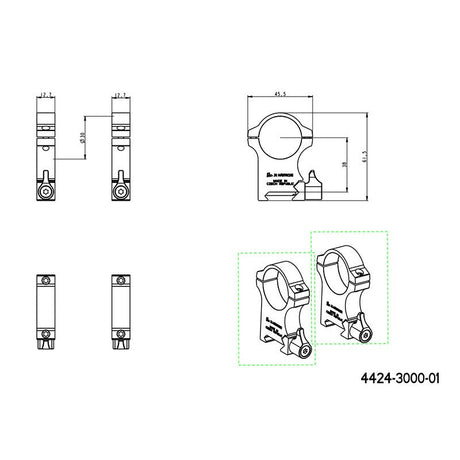
The height is measured from the center of the ring to the bottom of the mount. Rings come in low, medium and high versions. Choose the lowest height at which the objective lens and the eyepiece do not touch the rifle. A low scope gives a better cheek weld and a more stable head position. A scope with a large objective, for example 50 or 56 mm, needs higher rings. Each product names its height in mm.
Picatinny rings on a Weaver base
Picatinny rings do not always fit a Weaver base. Weaver slots can be narrower, and the spacing between them differs. For a Weaver base, the JK-N configurator rings are made to fit both. If you need a new base, a Picatinny rail gives you the widest choice of rings.
Separate rings or one-piece mount
-
Separate rings are two independent rings. You can set the distance between them to suit the length of your scope.
-
A one-piece mount holds both rings on one base. It keeps both rings in line and is quick to install.
-
A cantilever mount is a one-piece mount that moves the scope forward. It helps on rifles such as the AR-15 and AR-10. On these rifles the scope must sit further forward for the right eye relief.
Fixing to the base: screw nut, lever or QD
-
Screw nut: the ring is fixed to the rail with a nut. It is simple and stays in place, but you need a tool to remove it.
-
Lever: the ring is fixed with a lever. You can remove it by hand.
-
QD (quick detach): you remove and refit the scope by hand. The QD mounts from Davika keep their position when refitted, so the zero stays the same. They have adjustable tension and a safety button against opening by accident.
QD mounts suit you if you change between a scope and a thermal or night vision device on one rifle.
Tilt
Some mounts are available with a tilt in MOA. The tilt adds elevation, so you can zero at long distance without running out of elevation in the scope. For normal distances, choose 0 MOA.
Accessory interface
Davika scope mounts have the SMAI interface. It lets you attach accessories to the mount, for example a Picatinny rail section. See Add-on Picatinny rails for scope rings.
Modular rings
Modular ring systems from JK-N for Picatinny and Blaser are configured to order. You choose the diameter, the height and the length of the base. For the Blaser version, you choose between a short base of 114.2 mm and a long base of 139.2 mm.
Rings for rimfire and CZ rifles
The CZ 457 and CZ 600 have a dovetail on the receiver. The steel rings from CZ, made by JK-N, attach directly to this dovetail. You need no Picatinny rail. For the CZ 457, they come for 1 inch and 30 mm tubes. For the CZ 600, there are versions for the different upper receiver sizes, such as the medium receiver.
Ring spacing and eye relief
With separate rings, you can move the scope forward or back before you tighten it. Set the scope so you see the full image when your head is in a normal shooting position. Check this at the highest magnification, where eye relief is shortest on most variable scopes. Then tighten the rings.
Level the scope
The reticle must be level with the rifle. A tilted reticle moves the point of impact sideways at long distance. Level the scope before you tighten the ring screws. A bubble level on the scope tube helps you keep the rifle level while shooting. See Bubble levels for rifle scope.
Materials and installation
Most rings here are made of steel. Davika mounts are made of 7075-T6 aluminium with a hard anodized surface. Tighten the screws to the torque on the product page, for example 2 to 2.5 Nm. On Davika mounts, the clamping plate takes up to 5 Nm and the rings up to 3 Nm.
Frequently asked questions
Which rings do I need for my scope?
- Find the main tube diameter of your scope: 1 inch, 30 mm or 34 mm.
- Find the base on your rifle: Picatinny rail, Blaser interface or CZ dovetail.
- Find the objective lens diameter of your scope and choose the ring height.
- Choose rings that match all three points.
Which ring height should I choose?
The lowest height at which the scope does not touch the barrel or the receiver. Scopes with a large objective, for example 50 or 56 mm, need medium or high rings.
Will my scope keep its zero with QD rings?
The Davika QD mounts are made to return to the same position when you refit them. Check your zero after you refit the scope for the first time.
My rifle has no Picatinny rail. What do I need?
You have two options. Rings that fit the base of your rifle directly, such as dovetail rings for the CZ 457 and CZ 600. Or a Picatinny rail for your rifle model, plus Picatinny rings. See Picatinny rails.

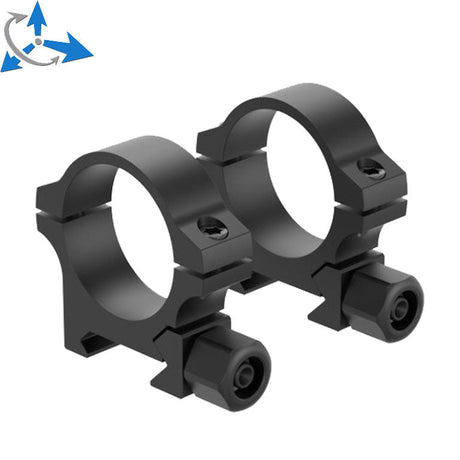
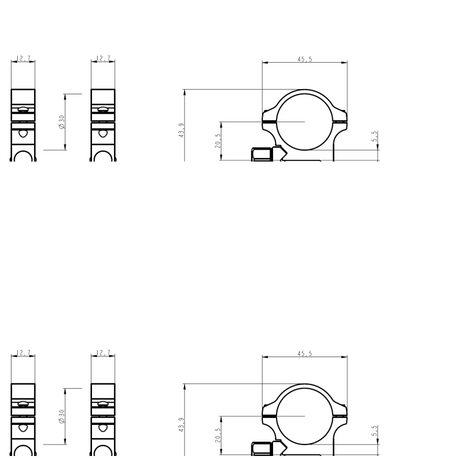
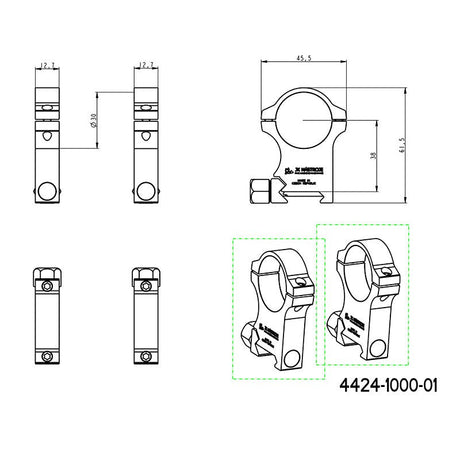
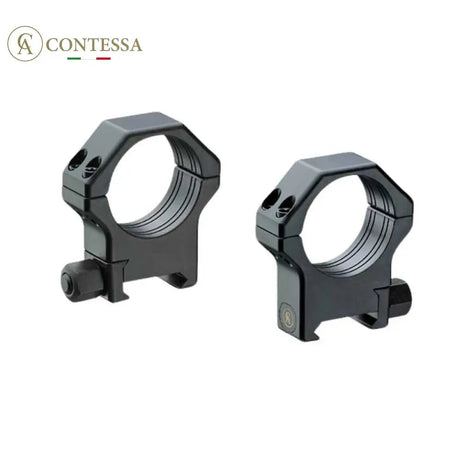
![30mm scope rings | Picatinny base with screw nut - Medium [12mm]](//www.optics-spot.co.uk/cdn/shop/files/30mm-scope-rings-picatinny-base-with-screw-nut-medium-12mm-667.webp?v=1747403570&width=460)
![30mm scope rings | Picatinny base with screw nut - High [19mm]](//www.optics-spot.co.uk/cdn/shop/files/30mm-scope-rings-picatinny-base-with-screw-nut-high-19mm-719.webp?v=1747403572&width=460)


![30mm scope rings | Picatinny base with screw nut - Low [8mm]](//www.optics-spot.co.uk/cdn/shop/files/Scope_rings_Contessa_89fcc0b9-5c89-4b63-99a8-1a1671baa7c6.jpg?v=1748423616&width=460)
![1’’ scope rings | Picatinny base with screw nut - Low [8mm]](//www.optics-spot.co.uk/cdn/shop/files/1-scope-rings-picatinny-base-with-screw-nut-low-8mm-604.webp?v=1747403560&width=460)
![1’’ scope rings | Picatinny base with screw nut - Medium [12mm]](//www.optics-spot.co.uk/cdn/shop/files/1-scope-rings-picatinny-base-with-screw-nut-medium-12mm-210.webp?v=1747403560&width=460)
![1’’ scope rings | Picatinny base with screw nut - High [19mm]](//www.optics-spot.co.uk/cdn/shop/files/1-scope-rings-picatinny-base-with-screw-nut-high-19mm-705.webp?v=1747403562&width=460)


![CZ 457 scope rings for dovetail | 1 inch [25.4mm]](//www.optics-spot.co.uk/cdn/shop/files/CZ_457_CZ_455_Scope_rings_for_dovetail_1inch.jpg?v=1747402348&width=460)
![CZ 457 scope rings for dovetail | 1 inch [25.4mm]](//www.optics-spot.co.uk/cdn/shop/files/4294-1000-01.png?v=1747402350&width=460)
![Modular scope rings system for Blaser [configurator]](//www.optics-spot.co.uk/cdn/shop/files/Modular_scope_rings_system_for_Blaser_configurator.jpg?v=1778730260&width=460)
![Modular scope rings system for Picatinny [configurator] - 1 inch [25.4 mm] / Low / Ergonomic short base (one-piece)](//www.optics-spot.co.uk/cdn/shop/files/Modular_scope_rings_system_for_Picatinny_configurator.webp?v=1778698539&width=460)
![Modular scope rings system for Picatinny [configurator] - 1 inch [25.4 mm] / Low / Ergonomic long base (one-piece)](//www.optics-spot.co.uk/cdn/shop/files/Modular_scope_rings_system_for_Picatinny_configurator__1.webp?v=1778698557&width=460)
![Modular scope rings system for Picatinny [configurator] - 1 inch [25.4 mm] / Low / Ergonomic base (two-piece)](//www.optics-spot.co.uk/cdn/shop/files/Modular_scope_rings_system_for_Picatinny_configurator__2.webp?v=1778698575&width=460)
![Modular scope rings system for Picatinny [configurator] - 1 inch [25.4 mm] / Low / Universal base (two piece)](//www.optics-spot.co.uk/cdn/shop/files/Modular_scope_rings_system_for_Picatinny_configurator__3.webp?v=1778698582&width=460)
![Modular scope rings system for Picatinny [configurator] - 1 inch [25.4 mm] / Low / Tactical long base (one-piece)](//www.optics-spot.co.uk/cdn/shop/files/Modular_scope_rings_system_for_Picatinny_configurator__4.webp?v=1778698591&width=460)
![Modular scope rings system for Picatinny [configurator] - 1 inch [25.4 mm] / Low / Tactical short base (one-piece)](//www.optics-spot.co.uk/cdn/shop/files/Scope_rings_with_Tactical_base_short_picatinny.jpg?v=1778728404&width=460)
![Picatinny base [rail] for Davika scope mounts & rings](//www.optics-spot.co.uk/cdn/shop/files/Picatinny_base_rail_for_Davika_scope_mounts_rings.jpg?v=1752515246&width=460)
![Picatinny base [rail] for Davika scope mounts & rings](//www.optics-spot.co.uk/cdn/shop/files/Picatinny_base_rail_for_Davika_scope_mounts_rings_1.webp?v=1752515247&width=460)
![Picatinny base [rail] for Davika scope mounts & rings](//www.optics-spot.co.uk/cdn/shop/files/Picatinny_base_rail_for_Davika_scope_mounts_rings_2.webp?v=1752515247&width=460)
![Picatinny base [rail] for Davika scope mounts & rings](//www.optics-spot.co.uk/cdn/shop/files/Picatinny_base_rail_for_Davika_scope_mounts_rings_3.webp?v=1752515247&width=460)
![Picatinny base [rail] for Davika scope mounts & rings](//www.optics-spot.co.uk/cdn/shop/files/Picatinny_base_rail_for_Davika_scope_mounts_rings_4.webp?v=1752515247&width=460)


![30mm scope rings | Picatinny base with screw nut - Medium [12mm]](http://www.optics-spot.co.uk/cdn/shop/files/30mm-scope-rings-picatinny-base-with-screw-nut-medium-12mm-667.webp?v=1747403570&width=460)
![30mm scope rings | Picatinny base with screw nut - High [19mm]](http://www.optics-spot.co.uk/cdn/shop/files/30mm-scope-rings-picatinny-base-with-screw-nut-high-19mm-719.webp?v=1747403572&width=460)


![30mm scope rings | Picatinny base with screw nut - Low [8mm]](http://www.optics-spot.co.uk/cdn/shop/files/Scope_rings_Contessa_89fcc0b9-5c89-4b63-99a8-1a1671baa7c6.jpg?v=1748423616&width=460)
![1’’ scope rings | Picatinny base with screw nut - Low [8mm]](http://www.optics-spot.co.uk/cdn/shop/files/1-scope-rings-picatinny-base-with-screw-nut-low-8mm-604.webp?v=1747403560&width=460)
![1’’ scope rings | Picatinny base with screw nut - Medium [12mm]](http://www.optics-spot.co.uk/cdn/shop/files/1-scope-rings-picatinny-base-with-screw-nut-medium-12mm-210.webp?v=1747403560&width=460)
![1’’ scope rings | Picatinny base with screw nut - High [19mm]](http://www.optics-spot.co.uk/cdn/shop/files/1-scope-rings-picatinny-base-with-screw-nut-high-19mm-705.webp?v=1747403562&width=460)


![CZ 457 scope rings for dovetail | 1 inch [25.4mm]](http://www.optics-spot.co.uk/cdn/shop/files/CZ_457_CZ_455_Scope_rings_for_dovetail_1inch.jpg?v=1747402348&width=460)
![CZ 457 scope rings for dovetail | 1 inch [25.4mm]](http://www.optics-spot.co.uk/cdn/shop/files/4294-1000-01.png?v=1747402350&width=460)
![Modular scope rings system for Blaser [configurator]](http://www.optics-spot.co.uk/cdn/shop/files/Modular_scope_rings_system_for_Blaser_configurator.jpg?v=1778730260&width=460)
![Modular scope rings system for Picatinny [configurator] - 1 inch [25.4 mm] / Low / Ergonomic short base (one-piece)](http://www.optics-spot.co.uk/cdn/shop/files/Modular_scope_rings_system_for_Picatinny_configurator.webp?v=1778698539&width=460)
![Modular scope rings system for Picatinny [configurator] - 1 inch [25.4 mm] / Low / Ergonomic long base (one-piece)](http://www.optics-spot.co.uk/cdn/shop/files/Modular_scope_rings_system_for_Picatinny_configurator__1.webp?v=1778698557&width=460)
![Modular scope rings system for Picatinny [configurator] - 1 inch [25.4 mm] / Low / Ergonomic base (two-piece)](http://www.optics-spot.co.uk/cdn/shop/files/Modular_scope_rings_system_for_Picatinny_configurator__2.webp?v=1778698575&width=460)
![Modular scope rings system for Picatinny [configurator] - 1 inch [25.4 mm] / Low / Universal base (two piece)](http://www.optics-spot.co.uk/cdn/shop/files/Modular_scope_rings_system_for_Picatinny_configurator__3.webp?v=1778698582&width=460)
![Modular scope rings system for Picatinny [configurator] - 1 inch [25.4 mm] / Low / Tactical long base (one-piece)](http://www.optics-spot.co.uk/cdn/shop/files/Modular_scope_rings_system_for_Picatinny_configurator__4.webp?v=1778698591&width=460)
![Modular scope rings system for Picatinny [configurator] - 1 inch [25.4 mm] / Low / Tactical short base (one-piece)](http://www.optics-spot.co.uk/cdn/shop/files/Scope_rings_with_Tactical_base_short_picatinny.jpg?v=1778728404&width=460)
![Picatinny base [rail] for Davika scope mounts & rings](http://www.optics-spot.co.uk/cdn/shop/files/Picatinny_base_rail_for_Davika_scope_mounts_rings.jpg?v=1752515246&width=460)
![Picatinny base [rail] for Davika scope mounts & rings](http://www.optics-spot.co.uk/cdn/shop/files/Picatinny_base_rail_for_Davika_scope_mounts_rings_1.webp?v=1752515247&width=460)
![Picatinny base [rail] for Davika scope mounts & rings](http://www.optics-spot.co.uk/cdn/shop/files/Picatinny_base_rail_for_Davika_scope_mounts_rings_2.webp?v=1752515247&width=460)
![Picatinny base [rail] for Davika scope mounts & rings](http://www.optics-spot.co.uk/cdn/shop/files/Picatinny_base_rail_for_Davika_scope_mounts_rings_3.webp?v=1752515247&width=460)
![Picatinny base [rail] for Davika scope mounts & rings](http://www.optics-spot.co.uk/cdn/shop/files/Picatinny_base_rail_for_Davika_scope_mounts_rings_4.webp?v=1752515247&width=460)


